
Marketing is important for businesses because it helps them bring in customers, make people aware of their brand, and increase sales.
As technology develops, there are more ways for companies to promote their products and services.Two main ways of doing this are digital marketing and traditional marketing.
Traditional marketing uses older methods like newspapers, TV, radio, magazines, and outdoor signs.
Digital marketing uses the internet through search engines, social media, websites, email, and online ads.
Both types of marketing aim to connect businesses with their customers.
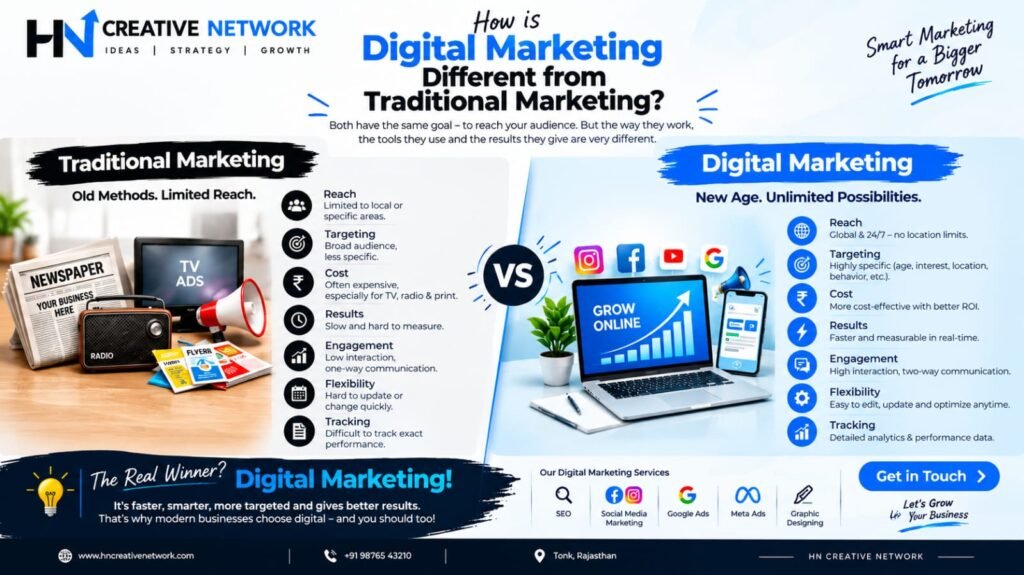
But they are different in how far they can reach, how they target audiences, how much they cost, how customers interact, how flexible they are, and how you can measure how well they work.
At HN Creative Network, we know how important it is to pick the right marketing strategy to help your business grow.
In this guide, we’ll explain the main differences between digital marketing and traditional marketing, and help you decide which might be better for your business.
What Is Traditional Marketing?
Traditional marketing refers to ways of promoting a business using offline methods.
It has been used by companies for many years to create brand recognition and send messages to a wide group of people.
Examples of traditional marketing include:
- Ads in newspapers and magazines
- TV commercials
- Radio ads
- Billboards and outdoor signs
- Flyers, brochures, and printed catalogs
- Direct mail campaigns
Traditional marketing works well for local promotions, community awareness, and reaching people who often use print or radio.
For example, a local store might place an ad in a newspaper or put up a sign in a local market to get nearby customers.
However, it can be hard to know exactly how many people saw the ad and how many of them actually became customers.
What Is Digital Marketing?
Digital marketing is about promoting products, services, and brands through online channels and digital tools.
It lets businesses connect with potential customers on the platforms they use daily.
Popular digital marketing methods include:
- Search Engine Optimization (SEO): Making a website show up higher in search results.
- Social Media Marketing: Promoting a business using social media platforms like Facebook, Instagram, and LinkedIn.
- Pay-Per-Click Advertising (PPC): Running paid ads on search engines or other online platforms.
- Content Marketing: Sharing helpful blogs, articles, videos, and other content.
- Email Marketing: Sending updates, offers, and useful information to email subscribers.
- Website Design and Optimization: Creating a website that is easy to use and helps reach business goals.
Digital marketing lets companies reach specific audiences, check how well their campaigns are working, and make changes based on real results.
For example, a company might use SEO to attract people looking for their services or run ads to get leads from potential customers.
Digital Marketing vs Traditional Marketing: 7 Key Differences
1.
Reach and Audience
Traditional marketing often targets a specific area or a general audience through offline media.
A newspaper ad might reach people in a local area, while a TV ad could reach a larger region.
Digital marketing can reach local, national, or even international audiences through online platforms.
Businesses can target customers based on their location, interests, and other factors, depending on the platform and campaign setup.
Winner: Digital marketing is more suitable for businesses that want to reach a wider audience or target certain customer groups.
2.
Cost and Budget
Traditional marketing can cost a lot because of printing, production, advertising space, and distribution.
The cost depends on the channel, the audience, the length of the campaign, and the location.
Digital marketing offers more flexible budget options.
Businesses can start with free methods like SEO and content marketing or choose paid ads based on their goals and resources.
Still, digital marketing can be expensive too.
Creating a website, producing content, running ads, and managing campaigns require investment.
Winner: Digital marketing usually allows for more control over the budget, especially for small businesses and new startups.
3.
Audience Targeting
Traditional ads can reach people who are not interested in the product or service being advertised.
While some offline channels allow targeting by age, gender, or location, the level of accuracy is limited.
Digital marketing lets businesses create campaigns that are tailored to specific factors like where people live, what they search for, their interests, and past actions, as long as the platform allows it and privacy laws are followed.
For example, a local service provider can run a campaign targeting only people in their area, instead of advertising to a much larger group that might not be interested.
Winner: Digital marketing usually gives more accurate targeting choices.
4.
Performance Measurement
It’s harder to measure how well traditional marketing works.
Businesses may use customer surveys, special codes, dedicated phone lines, or compare sales to guess how effective their efforts are.
Digital marketing platforms provide clear performance data, such as website visits, clicks, impressions, leads, conversions, and ad costs.
Tools like Google Analytics and Google Search Console help businesses track website traffic and how well their search efforts are working.
These metrics make it easier to find out which campaigns are working well and which need improvement.
Winner: Digital marketing typically offers more detailed and up-to-date performance tracking.
5.
Customer Engagement
Traditional marketing is mostly one-way.
Customers might see an ad, but they can’t usually respond right away.
Digital marketing allows for two-way conversations.
Customers can comment on social media, send messages, fill out contact forms, write reviews, and directly interact with brands.
Responding to questions and feedback helps businesses build trust and improve customer relationships.
Winner: Digital marketing offers more direct and interactive communication options.
6.
Flexibility and Speed
Traditional marketing materials, like ads, can take time to design, print, and distribute.
Making changes after they’re published might be expensive and time-consuming.
Digital campaigns can be adjusted quickly.
Businesses can update website content, change ad messages, test different designs, and modify budgets without much delay.
This ability to make fast changes helps marketers respond to customer needs and market changes.
Winner: Digital marketing typically provides more flexibility and quicker adjustments.
7.
Return on Investment (ROI)
ROI measures how much value is gained compared to the cost of the marketing activity.
Traditional marketing can be very effective, but linking an ad to a sale might need extra tracking methods.
Digital marketing makes it easier to connect campaign actions with leads, online purchases, and other measurable results if proper tracking is in place.
However, results aren’t always certain.
ROI depends on things like who the audience is, how much competition there is, pricing, campaign planning, website experience, and the quality of the product or service.
Winner: Digital marketing often makes it easier to track ROI, but the best method depends on the business and its goals.
Comparison Table: Digital Marketing vs Traditional Marketing
| Feature | Traditional Marketing | Digital Marketing |
|---|---|---|
| Main channels | TV, radio, newspapers, billboards | Websites, search engines, social media, email |
| Audience reach | Usually local or wide offline groups | Local, national, or global |
| Targeting | Often general or based on channels | More specific targeting options |
| Budget | May need higher upfront costs | Offers flexible organic and paid choices |
| Measurement | Often hard to track or estimate | Provides detailed performance data |
| Engagement | Usually less interactive | Supports direct and interactive communication |
| Updates | Can be slow and costly | Can be quickly updated |
| ROI tracking | Can be difficult | Easier with proper conversion tracking |
Which Marketing Strategy Is Best for Small Businesses?
For many small businesses, digital marketing is a good starting point because it opens up access to online audiences, offers flexible ways to promote, and provides clear performance data.
A business can build a website, share helpful content, improve how it appears in search results, and stay active on social media.
Local businesses can also benefit from local SEO, a well-kept Google Business Profile, and targeted campaigns that bring in new customers.
Traditional marketing can still be useful when a business wants to reach people in a specific area, promote a local event, distribute printed materials, or increase visibility in a physical location.
Sometimes, using both digital and traditional methods together can lead to better results than using just one.
For example, a business might use printed flyers to promote a local offer while also using social media ads and SEO to bring in more online customers.
The best strategy depends on the target audience, marketing budget, business goals, and available resources.
Why Businesses Should Invest in Digital Marketing
The way people look for products and services is changing.
More people are using search engines, social media, and websites to find what they need.
Having a strong digital presence can help businesses:
- Make their brand more visible online.
- Reach customers who are actively looking for their products or services.
- Get more qualified leads and sales chances.
- Build better relationships by sharing helpful content and staying in touch regularly.
- Keep track of how marketing efforts are doing and find ways to improve them.
- Make their brand look more trustworthy with a professional website.
Digital marketing needs planning, consistency, and continuous improvement.
Just having a website or social media profile doesn’t mean success.Businesses need a clear plan that connects their online efforts with their goals.
How HN Creative Network Can Help
At HN Creative Network, we think a good marketing plan should help achieve real business results and improve the customer experience.
Our digital services can help businesses build and grow their online presence through:
- Search Engine Optimization (SEO): Improve website structure, content quality, and how your site appears in search results.
- Social Media Marketing: Increase brand awareness and connect with the right audience.
- Google Ads: Reach customers through paid advertising that targets specific groups.
- Meta Ads: Promote your products and services using Facebook and Instagram ads.
- Graphic Design: Create a look that is consistent and professional across all your materials.
- Website Solutions: Build a solid online platform that represents your brand well.
Choosing the right mix of services depends on your business, industry, audience, and growth goals.
A well-thought-out plan can help you make better marketing decisions and grow your digital presence over time.
Conclusion
Both digital and traditional marketing play important roles in promoting a business.
Traditional methods can be great for local awareness, face-to-face interaction, and campaigns that need physical presence.
Digital marketing gives advantages in targeting the right people, being flexible with campaigns, communicating interactively, and measuring results.
It is especially useful for businesses that want to reach online customers and track their marketing success.
Businesses should not choose a strategy just because it’s popular.
They should think about their audience, budget, goals, and resources.
For many modern businesses, using digital marketing with selected traditional methods can create a balanced way to reach customers and build brand awareness.
Ready to grow your business online?
Connect with HN Creative Network to find digital marketing solutions that match your business goals.
Visit our website: https://hncreativenetwork.com/