
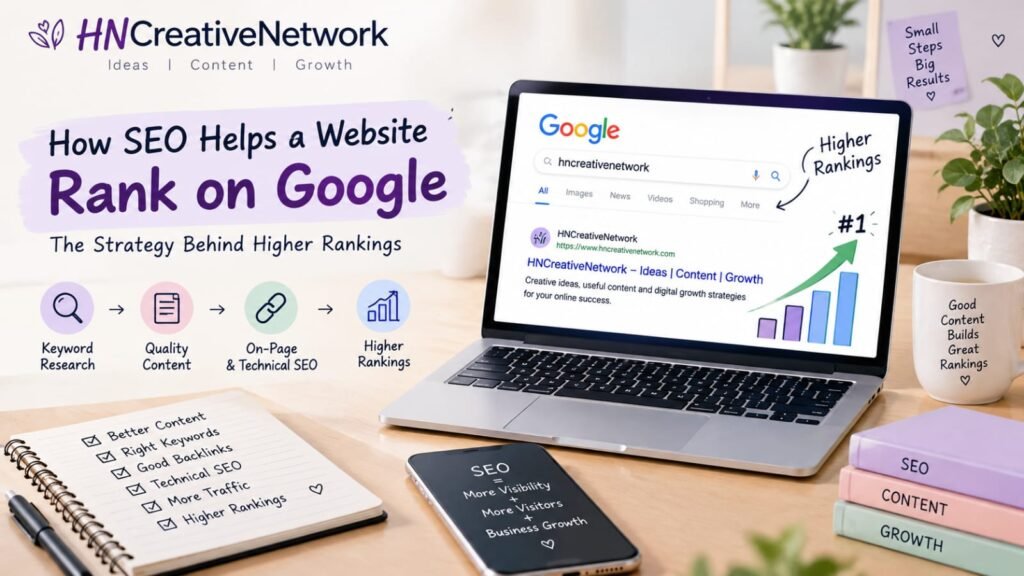
In today’s digital world, having a website is just the first step towards building a successful online business.
To attract visitors, generate leads, and increase brand awareness, people need to be able to find your website through search engines like Google.
This is where Search Engine Optimization (SEO) becomes important.
SEO is the process of improving a website so that search engines can understand its content and users can discover relevant pages through organic search results.
A well-planned SEO strategy can help businesses improve their online visibility, attract the right visitors, and build long-term credibility.
At HN Creative Network, we believe that effective SEO combines useful content, keyword research, technical improvements, and a positive user experience.
In this guide, we’ll explain how SEO works, which strategies can improve your website’s visibility, and why SEO is valuable for sustainable business growth.
What Is Search Engine Optimization (SEO)?
Search Engine Optimization, or SEO, involves improving a website’s content, structure, technical performance, and authority to help search engines find, understand, and evaluate its pages.
When someone searches Google for a product, service, or answer, Google tries to show results that are relevant and helpful to that search.
SEO helps businesses make their web pages more visible to search engines and more helpful to potential customers.
SEO generally includes three main areas:
- On-Page SEO: Improving page titles, headings, content, images, internal links, and other elements on a webpage.
- Technical SEO: Helping search engines crawl and index a website while improving aspects such as mobile usability, site performance, and website structure.
- Off-Page SEO: Building website authority and reputation through relevant backlinks, brand mentions, and other legitimate external signals.
These areas work together to support a website’s organic search performance.
However, no SEO technique can guarantee a specific ranking on Google.
1.
Keyword Research: Understand What Your Audience Searches For
Keyword research is one of the foundations of a successful SEO strategy.
It helps businesses understand the words and phrases people use when searching for information, products, or services.
Choosing relevant keywords allows you to create content that matches your audience’s needs.
For example, a digital marketing agency may target search phrases such as:
- Digital marketing services
- SEO services for small businesses
- Website design services
- Social media marketing services
- Digital marketing agency in Jaipur
The best keywords depend on your services, audience, competition, and website goals.
How to Perform Keyword Research
Start by identifying the products or services your business offers.
Think about the questions potential customers ask before making a decision.
You can use tools such as Google Keyword Planner, Google Search Console, and other keyword research platforms to find relevant search terms and evaluate available data.
Focus on search intent as well as keyword volume.
Someone searching for “what is SEO” may want educational information, while someone searching for “SEO services for my business” may be looking for a service provider.
Creating content that matches the searcher’s intent can make your website more useful and relevant.
2.
Quality Content: Give Users Helpful Information
High-quality content is an essential part of SEO.
Search engines aim to present useful results that satisfy the user’s search, so your content should answer questions clearly and provide real value.
Instead of writing articles just to include keywords, focus on explaining topics accurately and thoroughly.
Effective website content should:
- Answer the reader’s main question.
- Use clear headings and logical sections.
- Provide accurate and relevant information.
- Include practical examples where appropriate.
- Be easy to read on both mobile and desktop devices.
- Be original, useful, and regularly reviewed when necessary.
For example, an article about website SEO can explain keyword research, page optimization, internal linking, and technical SEO rather than repeating the same keyword throughout the page.
Businesses can also publish case studies, service guides, frequently asked questions, and educational blog posts to address customer needs.
Remember that publishing more content does not automatically lead to higher rankings.
Content quality, relevance, and usefulness matter.
On-Page SEO: Make Every Important Page Work Better
On-page SEO helps search engines and people understand what each page is about.
There are several things you should focus on when making a webpage better.
SEO Title
Write a title that clearly tells people what the page is about.
Use the main keyword in the title when it makes sense.
Meta Description
Write a short summary that tells people what they can find on the page.
A good meta description can make people want to visit your website, although Google might choose a different sentence to show in search results.
Headings
Use clear headings.
Start with one main heading and then use subheadings to organize the information.This helps readers find what they are looking for quickly.
URL Structure
Make sure your URLs are short and easy to read.
They should show what the page is about.Avoid long and confusing URLs when simpler options are available.
Image Optimization
Use relevant images and give them clear file names.
Add descriptions for images so search engines can understand them.Keep image sizes small so the page loads faster.
Internal Linking
Connect to other pages on your website using clear and meaningful links.
For example, if you have a blog about SEO, you can link to your SEO services page so readers can learn more.
These changes help make your website more organized and give visitors a better experience.
4.
Technical SEO: Make Your Website Easy for Search Engines to Find
Technical SEO looks at the hidden parts of your website that help search engines understand and find your pages.
Even great content might not show up in search results if the search engines can’t reach or read the pages.
Important technical SEO tasks include:
- Making sure your website is easy to visit and understand.
- Creating and sharing an XML sitemap when needed.
- Checking the rules in your robots.txt file.
- Fixing broken links and making sure error pages are clear.
- Using HTTPS to protect your website.
- Making your website work well on phones and tablets.
- Making pages load quickly.
- Checking for duplicate content and using canonical tags correctly.
- Using structured data when it’s useful.
Tools like Google Search Console and PageSpeed Insights can help you find problems and track how well your website is working.
You should check your technical SEO again after big changes, like website updates or redesigns.
5.
Backlinks: Build Trust from Other Websites
Backlinks are links from other websites that point to your website.
Helpful links that are earned naturally can help search engines see how your pages are connected and may help your website become more trusted.
Not all backlinks are the same.
Links created just to trick search engines can break the rules set by Google.
Your business should focus on getting good links by creating useful content, doing original research, contributing to the industry, forming real partnerships, and other honest ways to grow your audience.
Avoid buying lots of low-quality links or using automated methods to build links.
These actions can hurt how well your website performs in search results.
A good backlink plan focuses more on the quality and value of the links than just the number of links you have.
6.
Local SEO: Help People in Your Area Find You
Local SEO is useful for businesses that serve customers in a specific city or region.
For example, a service provider in Jaipur might want to reach people who are looking for web design, digital marketing, or other services in that area.
To improve your local visibility:
- Create and keep your Google Business Profile up to date if you’re eligible.
- Make sure your business name, address, phone number, and other details are the same across all platforms.
- Add location-specific content that helps customers.
- Encourage real customer reviews and respond in a friendly way.
- Add clear contact and service area information to your website.
- Make sure your website works well on mobile phones.
Local SEO can help your business become more visible to nearby customers, but search rankings depend on many things, like how relevant your business is, how far away you are, and how well-known you are.
7.
User Experience and Website Performance
Your website should not only be easy to find, but also easy to use.
People are more likely to stay on your website when the pages are clear, the navigation is simple, and the information is easy to find.
Important things to consider include:
- A design that works on mobile devices.
- Easy-to-read fonts and clear headings.
- Fast and stable page loading.
- Simple navigation and logical page layout.
- Links, buttons, and forms that are easy to use.
- Good content without annoying distractions.
Google looks at many things to decide how well a website works, but the main goal should be to make it easy and helpful for people visiting.
Just making a website easier to use doesn’t always make it rank better in search results.
How Long Does SEO Take to Show Results?
SEO is something that takes time, not something that works instantly.
Some changes, like fixing a problem with how a website is crawled or updating a page title, can happen quickly.
But it may take weeks or even months before you see real changes in how much traffic comes from search engines or how high a website ranks.
How fast you see results depends on several things: how competitive your industry is, how long your website has been around, the quality of your content, the technical health of your site, your industry, and how much effort and money you put into SEO.
You can check how well your website is doing using tools like Google Search Console and website analytics.
Look at how often your site shows up in search results, how many people click on your pages, what search terms people are using, and how well your pages are performing.
Use these findings to find new chances to improve and change your approach as time goes on.
How HN Creative Network Can Help
At HN Creative Network, we help businesses make their online presence stronger through useful digital solutions.
Our services include:
- Search Engine Optimization (SEO): Finding the right keywords, making sure your pages are set up well, improving how your website is structured and works technically, and making your content better.
- Website Design: Creating professional websites that show off your brand and help you reach your business goals.
- Social Media Marketing: Helping you connect with the right people through social media.
- Google Ads and Meta Ads: Supporting paid ad campaigns that match your business goals.
- Graphic Design: Making consistent visual materials used for your online marketing and branding.
Every business is different, so the best strategy depends on your goals, the people you want to reach, the industry you’re in, and what your website is doing now.
By putting together good content, making technical improvements, and keeping up with optimization, businesses can build a strong base for long-term growth through organic search.
Conclusion
SEO helps websites show up more often in search engines by making the content more relevant, easier to find, and useful for users.
Finding the right keywords helps you understand what people are looking for.
High-quality content answers their questions.On-page SEO helps your pages be organized and easier to read.Technical SEO helps search engines find and show your content properly.Backlinks from other websites can help make your site more trustworthy.Local SEO helps businesses reach people in the areas where they offer their services.
The best SEO strategy is one that is done regularly, focuses on the user, and is based on real data about how well your website is doing.
If you want to make your website more visible in search results, start by looking at your current pages, finding any technical issues, and creating content that answers what your audience is asking.
Ready to boost your online presence?
Connect with HN Creative Network to find SEO and digital marketing solutions that fit what your business needs.
Visit our website: https://hncreativenetwork.com/